Production planning that knows your factory.

growthOn is an Estonian software company that builds AI-based planning software for manufacturers. We bring your existing systems, your ERP, Excel and machines, together into one whole and teach the software the rules and exceptions of your production. When something changes, whether it is a rush order, a breakdown or a late delivery, the plan changes too, and everyone involved in the process sees the part of the plan that matters to them.

Week 43 · production plan● live
MonTueWedThuFri
CNC Homag
#2041
#2045 frames
RUSH #2050
Press
#2038
#2045
Glazing
#2041
#2050
Packing
#2038
#2050
⚡
Rush order received40 windows, delivery on Friday
↻
Plan updated#2045 moved to Wednesday on the CNC, deadline still holds
✓
Sales confirmed the delivery dateFriday, 23.10, customer informed
Knowledge base

A living memory of your factory's rules and decisions.

Every factory has rules that you will not find in any manual. They live in the planner's head, in old Excel comments and in what gets said at meetings. When that person is on holiday, so are the rules. When they leave, the rules leave with them.

The knowledge base gathers these rules from the places where they come about: meeting recordings, emails, changes in the system and everyday corrections. Nobody has to document anything separately, because the knowledge is collected as the work gets done. Every rule is given a source and a validity period, so you can always see when and why it changed. And when the system does not know the answer, it asks instead of guessing.

You can use it through the AI tool you already work with, so there is no separate program to learn. A new person asks instead of searching. And when the written instructions and the factory's actual practice drift apart, it comes to light.

What glazing bead width goes with a 54 mm frame?
16 mm. The rule changed in autumn 2025. The old table says 12 mm, which is out of date. Also: rows P44-6, P44-8 and P44-10 are not in use; they were added to the table by following the pattern.Source: production meeting 10.2025 · confirmed by the production manager
Planning

A plan that changes with the day.

In most factories the plan is put together in some piece of software or in Excel, and then real life starts changing it. A rush order cuts in, someone falls ill, a delivery is late. Every change means redoing the plan, redoing it takes hours, and the answers to sales come late. One production manager told us that just drawing up the monthly plan took 2-3 full working days, and redoing it took up a very large share of their working time.

With growthOn, orders go into the system straight from the inbox, without anyone having to enter them a second time. The system knows your work centres, set-up times, people's skills and your own rules, for example how many frames a week the CNC can really get through. The weekly plan is built according to these rules, and every change reaches the operators' screens straight away, rather than ending up on paper or waiting for the morning meeting.

When the plan changes, sales can see immediately where a new order fits and what it means for the other orders. That way you can answer the customer before they call the next supplier.
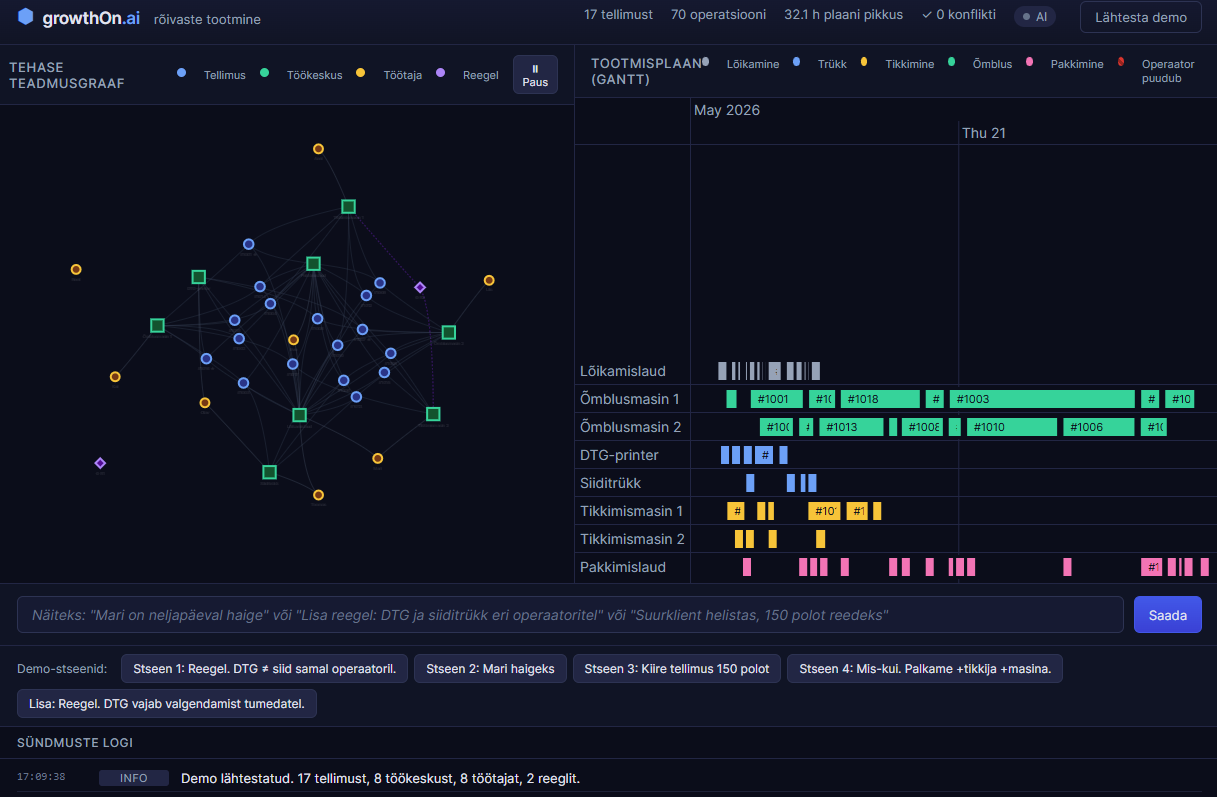
Screenshot of the growthOn planner
Work station views

A live overview of where production stands.

When work orders move around on paper and workers report into Excel at the end of the day, nobody knows during the day where anything is. The answer only comes out in the evening, when nothing can be changed any more.

In the growthOn work station view, operators see their work for the day and mark the start, pauses and completion themselves. If a job is left unfinished, the reason is recorded, and the system learns from that as well. At one window factory, 13 of these views are in use every day, from preparation to packing, on dust-proof workstations with QR scanners and label printers.

The system understands different kinds of stoppage and acts accordingly. For example, scrap and a fault are separate concepts. Marking something as scrap triggers an order for replacement material within the same week, instead of waiting for someone to notice the shortfall.

CNC Bacci#2045 frames · 18 / 24 pcs
in progress
Press#2038 · completed 10:42
done
Glazing#2041 · waiting for glass (delivery 11:30)
waiting
Final assembly#2036 · 2 pcs scrapped, replacement ordered
in progress
Integrations

Works with your systems, not instead of them.

No company replaces its accounting software or ERP just so that things are a little more convenient afterwards. That is why we do not offer you a big new system. Instead, we connect to what already works for you: ERP, accounting, Excel, email, machines.

Orders come from the inbox straight into the system. Machines with a network interface report their own status: at one factory the planer is connected so that stoppages and faults are visible on the manager's screen and can be searched in the history. For older machines, an intermediate layer can be built in front of the machine to receive the requests, without having to connect the machine itself to the network.

The software can run on your own server. For the AI model we use Mistral, a European company. Every AI agent has a narrow task and can be traced: if an error appears somewhere, you can see which agent made it and with which settings, and fix exactly that spot.


ERP
Accounting
Excel
Email
growthOn
Production equipment
Cloud folders
Time tracking
And much more
Sound familiar?

Everyday life in production.

We regularly visit Estonian manufacturers of all kinds to learn about their everyday challenges and understand them as well as we can. Some of our findings are unique, and some come up again and again from one factory to the next, whether they make windows and doors, plastics, equipment or soup.

01

The plan keeps changing

Drawing up the monthly plan by hand takes 2-3 full working days. Then a rush order comes in or a component fails to arrive, and everything starts again from scratch. One production manager told us that planning and replanning took up a very large share of their working time, and in their view it is the same for most people today.

02

Data is in ten places, and the whole picture is hard to see

Sales is in Excel, production in another program, machine data in the machines and everything else in people's heads. For example, it is quite normal for the stock figure to show 30 September for the whole month and only change on 31 October. The real profit on an order becomes clear weeks after delivery, if at all.

03

Rules live in one person's head

“More than 400 frames a week clogs up the CNC” is a rule of thumb that one person knows. In the food industry: pea soup has to be the first product of the day because it was soaked the day before, and after it comes a soup with the same ingredients, otherwise the line has to be washed in between. Every factory has hundreds of rules like these, and they are all scattered.

04

Things are left to the last minute

Production has been in the calendar for a long time, but the customer's final confirmation and exact measurements arrive late. Then it is “rush, rush, rush”, and rushing leads to mistakes. A wrong measurement reaches production, production does everything correctly, but the product does not fit, and production ends up paying for the rework.

05

Raw materials take up space or go off

For example, all the raw materials needed for a food product have been ordered, but one component did not arrive and the planned product was dropped from the plan. Could something else be made from the same raw materials before they go off? Answering that requires someone to see stock levels, recipes and the plan all at once. Often nobody can keep track of all of it, and the cost of the raw materials is simply written off.

06

The same thing is entered several times

One manufacturer receives orders from 54 customers in 54 different formats, using the customers' own article numbers, and sometimes there is a person in the middle acting as a translator. At another factory, two people enter orders by hand: if one falls ill or leaves, there is an immediate gap, and a tired person makes slip-ups.

Everyone promised. Nobody really delivered.

If these problems are so common, why has software not solved them long ago? We put this question to production managers who have seen dozens of vendors over the years. The same answers kept coming back.

Over the course of their career, one production manager has seen more than ten companies get the chance to show that they could solve production planning. They all came with the same story: we will sort out the order of your products, we will sort out your productivity. The production manager described all the rules and dependencies to them. None of the solutions ever went into use, because there were so many nuances and connections that nobody managed to build them into the program. In their own words: everyone promised, but nobody delivered.

A second pattern was described to us by an ERP consultant with 25 years of production experience: the vendor tells the customer that your production really is that special, so it cannot be done with off-the-shelf software, but we will build you something custom. Custom development costs several tens of thousands, and every later change is a new invoice. That is where the vendors' margin comes from. In reality, production processes are fairly similar. What differs are the rules and exceptions, and those are exactly what custom development leaves out.

The third reason is the ERP itself. ERP systems are built around the needs of accounting, and the production modules are bolted on. That is why cost prices and management accounting are still done in Excel. And no company is going to replace its business software because something is not working in production: it is too big and too risky a step.

The honest summary is this: around 95 per cent of a factory's rules are simple, and any competent software developer can build them into a program. What stands in the way of a solution that really works is the remaining five per cent: the exceptions, the constantly changing variables and the connections that a programmer never manages to capture in formulas. That is exactly where previous solutions have got stuck.

A rule used to have to be programmed. Now it can be taught.

Large language models changed one thing fundamentally for production software: a rule no longer has to be programmed, it can be described. An AI agent picks up the rule from a meeting recording, an email or the way your people correct the system day to day, and starts taking it into account in the plan. What used to look like an endless chain of formulas can now be learned. That is the reason our solution has only become possible now, and not ten years ago.

But we do not believe in blind automation, and neither do our customers. Several partners have told us about earlier AI purchases that were never put into use because the solution was superficial and the price was hidden.

That is why every rule in our system can be checked. It has a source and a validity period, a person confirms it, and when the system does not know the answer, it asks instead of guessing. The AI suggests, a person confirms, and only once trust has been built is more handed over to automation, step by step. Your factory is not left running on a black box.

What manufacturers have experienced so far

  • A new ERP or expensive custom development, and the old system gets thrown out
  • The rules are described to a developer, and half of them get lost in translation
  • Every change is a new development order and a new invoice
  • The system keeps applying old rules and does not tell you they are out of date
  • The price only becomes clear after a long analysis

growthOn

  • We connect to what you already have: ERP, accounting, Excel, machines.
  • The knowledge base learns your rules and exceptions from meetings, emails and the decisions that are actually made.
  • The solution evolves along with the rest of your production. When you add new machines or change rules or anything else, there is no need to order extra development, because the system adapts by itself.
  • The system shows when and why a rule changed, and asks when it does not know the answer.
  • The price is stated on this page, and the first visit comes with no obligation.

Team

We are a small Estonian team. That means two things: you always talk to someone who really knows your system, and we cannot afford a project that fails.

Martin Rebane

Martin Rebane

CEO, co-founder

AI and robotics engineer, PhD (University of Warwick). Previously head of AI at Tartu Science Park, researcher at TalTech and senior developer at LHV.

Hristo Neiland

Hristo Neiland

Chief Growth Officer (CGO)

Builds growthOn's sales and marketing. His background is in project management and securing grant funding.

LJ

Liisa Jõgiste

Lead Software Engineer

.NET developer and TalTech lecturer for more than 11 years. Previously at Skype and Helmes.

Karl-Erik Kanal

Karl-Erik Kanal

Software Engineer

Machine learning engineer, MSc in Data Science (University of Tartu).

Who we build for, and who we don't.

Our customers are not defined by a particular size or a particular industry, but by a particular problem. If your production is made to order, your products come in many variants and the plan changes more often than a whiteboard or Excel can keep up with, we can be useful to you. The same applies if you have an ERP but production still lives in Excel, or if critical rules are in the heads of one or two people. Our clients include manufacturers with a few dozen employees as well as ones with several hundred.

And to be honest about the other side as well: if your planning is already covered by a system and it really works, we may not be your next step. We will tell you so plainly during the factory visit if we see that our solution would not bring you any gain.

Four steps from a factory visit to a working system.

1

Factory visit

We come to you, walk through production and listen. The aim is not to sell, but to understand where your most costly problem lies and whether we are able to solve it. If we are not, we will say so the same day.

1 day
2

Mapping

We write down your rules, exceptions and systems: what comes from where, who decides what, and where information gets lost today. Together we choose the first problem to tackle, and we make you an offer for it with a price.

2-4 weeks
3

Integration and rollout

We connect to your systems and put the first part to work on real orders. We roll it out together with your people at the factory, not from a distance.

1-3 months
4

Training and support

Instructions and training in Estonian are included in the contract. From then on you change the rules yourselves, without a development order, and the system grows with you.

ongoing

A clear price before we start.

The final price depends on how many systems and workstations we connect, so it is settled after the mapping. These are the starting points.

Knowledge base

19 000 € implementation
  • First two years of use included in the price
  • After that, 5 000 € a year
  • Up and running within 3 months
Request a quote
Our recommendation

Licence-based

Lower initial payment
  • Annual licence fee, with the scope set to your needs
  • Modules are added under the same licence
  • The system stays up to date without new development
Invite us to your factory

Project with advance payment

20 % advance payment
  • The rest after full implementation
  • Maintenance up to 300 € a month
  • The software remains yours to use
Request a quote
Grant funding

Part of the cost may be covered by a grant. We will help you find it.

Estonian manufacturers often do not have to pay for a product like this entirely out of their own pocket. For example, the Enterprise Estonia (EIS) digitalisation roadmap development grant covers 50% of a project's eligible costs, and up to 70% outside Harju County and the city of Tartu. The grant requires a valid digitalisation roadmap. Applications for the AI adoption grant are currently on hold.

Applying for a grant is a job in itself, and we do it together with you: we look at which measure suits you, help you describe the project, put the budget together and submit the application.

up to 70 %of eligible costs covered by the digitalisation roadmap grant outside Harju County and the city of Tartu

Questions manufacturers ask us.

Do we have to replace our ERP?

No. growthOn works alongside your ERP, accounting software and Excel, and takes the data from where it already is. If one of those systems is ever replaced, growthOn simply comes along.

How long does implementation take?

The knowledge base is up and running within three months. For the planner, the time depends on how many systems we connect and how quickly their vendors respond. We give you a time estimate at the end of the mapping and explain how we arrived at it.

Where is our data kept and who can see it?

The software can run on your own server. The contract sets out which AI services may be used and who sees which information. You grant access yourselves, by role and by topic, and adding a new employee is done in-house without us.

What happens if the internet goes down?

Production does not stop. The system has an offline mode that keeps working and synchronises once the connection is back.

Is our factory too small for this?

If you have around ten or more employees and planning takes up someone's working time every week, you are not too small. Our customers are mostly manufacturers with a turnover of 1-10 million euros.

Why should we trust you when earlier solutions failed for us?

That is exactly why we start small: one problem, a clear price and a result that works on real orders. Each next step only comes once the previous one has proven itself. And if we see that you would not gain anything, we will say so at the first visit.

Invite us to visit your production.

We come to you, walk through production and tell you honestly whether and where we can help. If we cannot, we will tell you that too. The first visit comes with no obligation.

  • We reply within one working day
  • Meeting at your factory or by video
  • No obligation
Or write to us directly: hristo@growthon.aiWe use your details only to reply to your enquiry. Privacy policy

Thank you!

We have received your enquiry. We will get in touch within one working day.